

Welcome to Vantage Explorations’ Amsterdam to Bergen: A Northern Saga
Sailing in the tradition of the ancient narrative named by the Norsemen as Sagas, our journey emulates the people of the northern shores of Europe and Scandinavia. These iconic lands, shaped by centuries of exploration, trade and conquest, echo with the legacy of seafarers whose fortunes were won and lost upon these shores. The spirit of the Sagas comes alive as we hike the shores of Sweden, visit Viking homelands and navigate Europe’s Kiel Canal. We’ll encounter the legacy of Hanseatic merchants and Scandinavian dynasties, whose wealth and ambition shaped the fortresses, palaces and historic ports that still define these shores today. From the heartland of Germany to the maritime heart of Scandinavia, every harbour, fjord and horizon tells a story, while together we add our own chapter to our enduring northern Saga.
Arrive at Amsterdam Airport Schiphol and transfer to our Embarkation Suite (conditions apply below). Explore Amsterdam at your leisure before returning to our Embarkation Suite at the designated times for the group transfer to Douglas Mawson.
Important information:
- Complimentary airport arrival transfers are provided as group transfers for expeditioners arriving at Amsterdam Airport Schiphol prior to 11:00am on Day 1 only.
- Passengers who arrive after the airport transfer cut-off will need to make their own way to the Embarkation Suite before 1:00 pm to complete mandatory check-in.
- For passengers already in Amsterdam, we ask you to visit our centrally located Embarkation Suite with all luggage, which will be open for mandatory check-in between 9:00 am and 1:00 pm.
- Passengers have access to our centrally located Embarkation Suite, including luggage storage, Vantage Explorations staff for voyage and city information and cabin check-in, WIFI, tea, coffee and light refreshments. Embarkation Suite location: to be advised closer to date of departure.
- As your luggage will be transported to the ship at 2.00pm and ahead of you, please ensure you place any items you require during the day in your day bag, including passports, cash/cards and medicines.
In the late afternoon join a mandatory group transfer to board the Douglas Mawson. After boarding, there’s time to settle into your cabin before our important safety briefings before we ‘throw the lines’ to begin our voyage.
This evening, join your fellow travellers for an onboard Welcome Dinner, where your expedition team will introduce you to the expedition ahead and raise a toast to the adventures to come.
Meals: Dinner onboard
Our day at sea offers the perfect opportunity to get to know your fellow passengers, onboard team and our ship with a range of presentations on offer. Between insights on sailing and scanning the horizon, there’s time to unwind and enjoy the ship’s amenities, whether it’s a quiet moment on deck or a drink with a view. As we sail, the outer Dutch islands gradually give way to the German coastline, setting the stage for our arrival the following morning at one of Europe’s most impressive engineering wonders.
You can’t travel through Germany without encountering its vast network of navigable waterways, but none are as iconic or strategically important as the Kiel Canal. Often called Europe’s Panama, this 98-kilometre (61-mile) engineering feat slices through the narrow waist of Schleswig-Holstein, cutting the Jutland Peninsula from mainland Europe and offering Baltic-bound ships a shortcut that saves 460 kilometres (286 miles) of open-sea navigation around Denmark.
Carved by hand over eight demanding years by 9,000 workers, the canal opened in 1895 as the Kaiser-Wilhelm-Kanal, but as Germany’s naval power surged, it had to be widened by hand once more to accommodate a new generation of battleships. Today, renamed the Nord-Ostsee-Kanal, but often simply called the Kiel Canal, it remains one of the most fascinating waterways, attracting 90 to 130 vessels daily.
Thanks to our boutique ship’s compact size, we’re able to navigate this rare inland passage, an experience off-limits to today’s towering cruise giants. Our daytime transit offers a front-row view of the canal’s working locks, designed not for elevation but to manage the tidal flow between seas. As we glide through peaceful stretches of countryside, the scenery becomes unmistakably German: wide meadows, red-brick farmhouses, and the occasional herd of cows watching from the banks. It’s one of the few journeys in Europe where tranquillity still reigns and where you're more likely to spot a tractor or a fishing rod than another tourist.
Arriving at Wismar, we drive 30 minutes inland from the Hanseatic coast to a prize born of one of history’s most powerful trading networks; Schwerin Castle. This was the seat of the Grand Dukes of Mecklenburg-Schwerin, a ruling house sustained over centuries by wealth driven by the influence of the Hanseatic League, whose powerful trading network shaped northern Europe. Ports from England to Russia, Holland to the Rhine, prospered through the movement of salt, grain, timber, and fish across the Baltic, generating the economic strength that supported Ducal courts like Schwerin. Here, political authority and maritime commerce were closely linked, power inland depended on wealth from the sea. In the 19th century, as Europe modernised and old hierarchies were challenged, the ruling dukes transformed the castle into the monumental residence seen today. Its scale and opulence were not defensive, but declarative, a statement of status in a changing world.
Returning to Wismar there is time this afternoon to explore this traditional Hanseatic town independently. Wandering its streets you sense a rhythm shaped by centuries of trade and the steady pulse of the Baltic. The wide market squares, stepped gables, and red‑brick façades speak of a time when merchants struck deals in the squares, fortunes were made and lost wealth arrived with ships from across northern Europe.
We disembark this morning in the historic port of Rostock (Warnemünde) and drive to Berlin, where we will spend the night, allowing time for a deeper and more meaningful exploration of this remarkable city.
Few cities reveal their history as vividly, or as powerfully, as Berlin. Once the heart of Prussian royalty and imperial ambition, it grew into a centre of cultural and intellectual brilliance, its grand boulevards and monumental architecture reflecting both confidence and prestige. Yet the 20th century reshaped Berlin profoundly. Following the devastation of the First World War and the hardship that followed, the city became the capital of Nazi Germany, where a dark ideology took hold. The Second World War left Berlin in ruins, and in its aftermath, the city was divided, mirroring the fractured world around it. The Berlin Wall, erected in 1961, became the starkest symbol of the Cold War, separating not only a city, but an entire continent for nearly thirty years.
Our overnight stay offers a compelling insight into a city defined by both turmoil and resilience. This afternoon, our local guide brings Berlin’s layered past into focus as we step into its historic heart. Along Unter den Linden, the great boulevard of Prussian power, we encounter the city’s imperial legacy, framed by landmarks such as the Brandenburg Gate and the Reichstag.
We then visit the Topography of Terror, located on the former site of the Gestapo and SS headquarters. Despite its unlikely name, the museum offers a sobering and powerful examination of Nazi rule, presenting photographs, documents, and personal testimonies that illuminate the chilling actions that incurred. Along its perimeter stands one of the longest remaining sections of the Berlin Wall. Through accounts of separation, control, and daring escapes, the human story of the Wall is brought vividly to life by our local guides who share stories of daily life in former East Germany, offering an insight into the realities of life behind the’ Iron Curtain.’
The narrative of oppression continues at the Jewish Museum, an extraordinary space that goes beyond architecture to tell deeply personal stories of Jewish life in Germany. Through poignant exhibits and artefacts donated by families affected by the Holocaust, we gain a deeper understanding of loss, resilience, and the enduring strength of the Jewish community.
This evening, we overnight in Berlin, giving you the opportunity to experience the city after dark, should you wish, from its historic streets to its vibrant contemporary culture.
Accommodation: Berlin Hotel
Meals: Breakfast, lunch, dinner
Our morning in Berlin offers you the opportunity to explore this remarkable city at your own pace and according to your own interests, before we depart for Rostock mid‑afternoon. With its rich layers of history and culture, Berlin truly offers something for everyone.
Art and history enthusiasts may wish to explore Museum Island, a UNESCO World Heritage Site at the heart of the city, where a collection of world‑renowned museums houses treasures spanning thousands of years. At its centre is the celebrated Pergamon Museum, famed for its breathtaking monumental treasures, including the extraordinary 2nd century BC Pergamon Altar, that once stood at the heart of an ancient Greek sanctuary, its dramatic friezes depicting mythological battles in astonishing detail and scale.
For those drawn to the Cold War era, the DDR Museum offers a highly engaging and immersive look at everyday life in East Germany. Among its displays are a range of personal mementos, from the iconic East German Trabant to everyday items such as a worker’s pay book, offering an intimate glimpse into daily life under the former regime.
Perhaps visit Checkpoint Charlie, once the most famous crossing point between East and West Berlin, which today stands as a powerful reminder of a divided world and the tensions that once defined it. Here, the human stories behind the border come into focus; those who risked everything to escape, and the very different outcomes they faced offering a deeply personal insight into life on either side of the Wall.
Alternatively, you may choose to climb to the top of the Reichstag, home to the German Parliament, where its striking glass dome offers panoramic views across Berlin. More than just a viewpoint, it tells the story of power in the city, how it rose through imperial ambition, was shattered by war and division, and has been reimagined in the form of a modern, transparent democracy.
Whether your interests lie in history, art, architecture, or simply soaking up the atmosphere, this free time allows you to experience Berlin in your own way before we depart for Rostock early afternoon to reboard Douglas Mawson, and sail north to Scandinavia.
Meals: Breakfast, Dinner onboard (To maximise your time at leisure in Berlin, lunch has been left at your own discretion today)
Arriving in the Danish Capital of Copenhagen we find a city where Scandinavian tradition meets modern Nordic cool. Home to three royal palaces, and nearly a quarter of Denmark's population this casual capital reflects centuries of regal heritage alongside a progressive, sustainability focussed spirit. Consistently ranked among the world’s most liveable cities, Copenhagen is celebrated for its clean, human-centred design and its effortless blend of historical buildings and sustainable suburbs. Nowhere is this clearer than along its transformed harbourfront. Once industrial, now reimagined through clever engineering, the former warehouses are now a vibrant public space. With clean swimming zones, open promenades, and a buzzing café scene, Copenhagen showcases how Danish design is not only functional but fun. Here life is meant to be well-lived, so get ready for an enjoyable day in Denmark's cool capital.
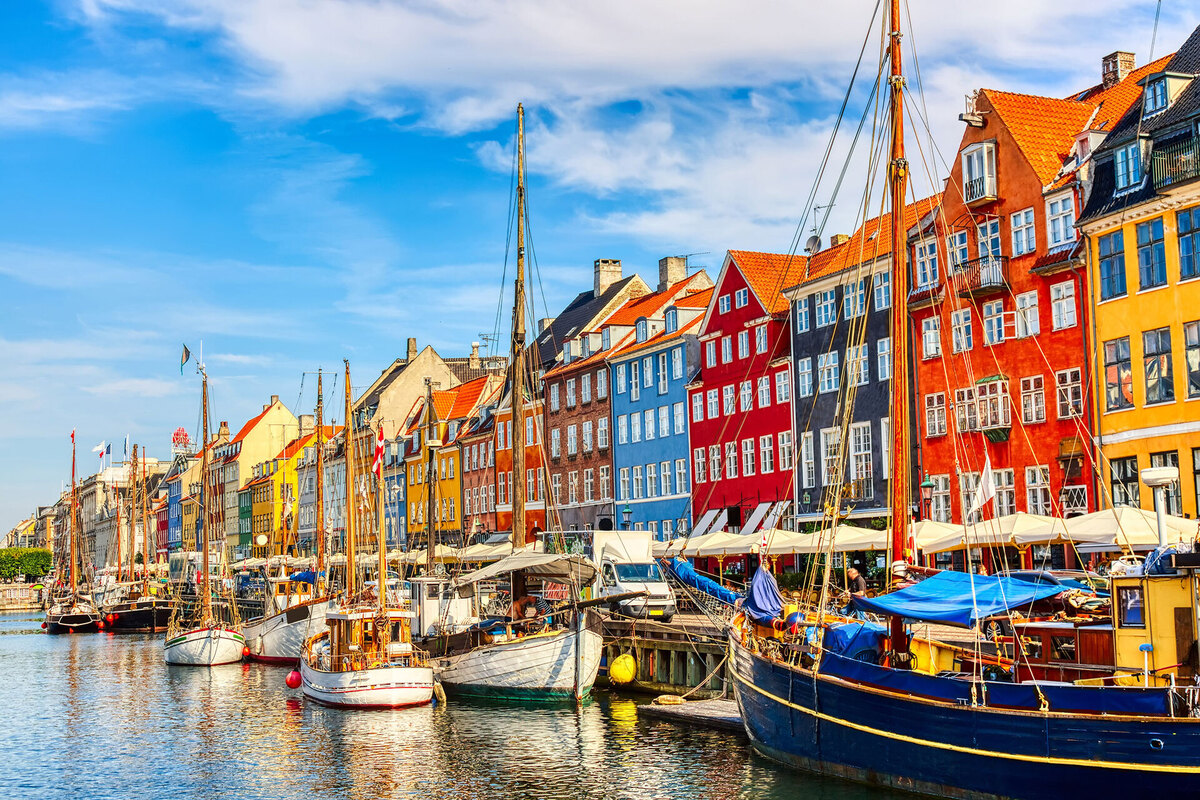
Our ‘Your Choice’ morning experiences bring to life some of Denmark’s most cherished stories, before both conclude in Copenhagen’s iconic harbour of Nyhavn, set in the very heart of the city and framed by colourful 17th‑century townhouses, historic wooden sailing boats, and inviting cafés.
This afternoon is yours to enjoy at leisure, offering the perfect opportunity to further explore this wonderfully walkable city, whether strolling its charming streets, discovering hidden corners, or simply soaking up the relaxed rhythm of Copenhagen at your own pace.
Personalise your exploration with our included ‘Your Choice’ experiences.
Option 1 – Morning experience: Cycling Copenhagen
A city of cyclists, Copenhagen embraces a healthy, active lifestyle, with bicycles an essential part of daily life for many Danes. After collecting our e-bikes, we’ll join a local guide to pedal along the waterfront, learning how the Danish capital has become a global leader in sustainable urban living.
Along the way, we’ll stop at the iconic Little Mermaid to hear tales of Denmark’s beloved storyteller, Hans Christian Andersen, before exploring the historic ramparts of Kastellet. We then spend time at the Museum of Danish Resistance, where the story of Denmark during World War II comes to life, including the efforts of King Christian X and the Danish people to protect their Jewish population.
Continuing into Copenhagen’s royal heart, we’ll pass Amalienborg Palace, home of King Frederik X and Queen Mary, and admire the magnificent Frederik’s Church, better known as the Marble Church, whose impressive dome dominates the skyline. Our tour concludes amid the colourful waterfront houses, historic vessels, and lively atmosphere of Nyhavn. From here, you may either return to the ship with your guide or remain in the city centre to enjoy more time exploring Copenhagen at your own pace before the ship’s late-afternoon departure.
Option 2 – Morning experience: Denmark’s Literary Legacy – from Hans Christian Andersen to Hamlet
From Hans Christian Andersen to Shakespeare’s Hamlet, we visit the extremes of literature this morning, on a locally guided tour from Denmark’s most beloved storyteller to the inspiration behind the Bard’s greatest tragedy.
As we weave through Copenhagen, our guide brings Andersen’s own remarkable life story to life, tracing his journey from humble beginnings to global fame. Along the harbour we pause at the Little Mermaid, inspired by his timeless tale, before visiting a statue dedicated to the author, one of many sites celebrating a figure Denmark is immensely proud of.
Heading north, we arrive at Kronborg Castle in Helsingør, a UNESCO-listed Renaissance fortress built to control the narrow Øresund and the passing trade. Within its grand halls and shadowed corridors, once alive with courtiers, soldiers, and intrigue, the atmosphere feels unmistakably theatrical. It’s easy to imagine a world of whispered secrets and watchful eyes—echoing the tension of Hamlet. Though Shakespeare never visited, Kronborg’s dramatic history of power, performance, and conflict clearly helped inspire his immortal tragedy.
Returning to Copenhagen, choose to return directly to the ship or be dropped in the city centre at Nyhavn, where colourful waterfront houses, historic sailing ships and lively cafés provide the perfect setting to continue exploring the Danish capital at their own pace.
Today we leave the cities behind to experience life on one of Sweden’s most enchanting car-free islands. For centuries, Marstrand has been a meeting place for sailors, traders, and travellers, and today remains one of the jewels of Sweden’s west coast, renowned for its colourful wooden houses, busy harbour and proud maritime traditions.
We start our ‘island time’ with a 5-kilometre (3-mile) walk which circumnavigates the island, following scenic seafront paths that reveal dramatic granite shorelines, sweeping sea views and the ever-changing landscapes of the Bohuslän archipelago. Along the way, discover Marstrand’s rich history, from its role as an important trading port to its enduring reputation as Sweden’s sailing capital.
Return to the ship or spend the afternoon exploring Marstrand at your own pace. Perhaps take a tour of the imposing Carlsten Fortress. Dominating the skyline this imposing 17th-century fortress has watched over the island and surrounding waters for more than three centuries, serving not only as a military stronghold but also as a state prison, housing some of Sweden’s most notorious inmates. Today, its ramparts, chambers and towers offer fascinating insights into the island’s history. Alternatively, simply wander the harbour, enjoy the island’s relaxed atmosphere and savour a little more time in one of Sweden’s most charming coastal communities.
Today we take to our Zodiacs to explore the waters of Kosterhavet National Park, Sweden's first marine national park. Situated along the country's rugged west coast near the Norwegian border, this protected area encompasses a rich archipelago of rocky islets, sheltered channels and pristine coastal landscapes.
Cruising through these calm waters, we discover a landscape shaped by wind, sea and ice, where smooth granite shores meet crystal-clear waters. Kosterhavet is renowned for its diverse marine biodiversity, supporting seals, seabirds and marine life.
Nestled at the head of the Oslofjord, Oslo traces its origins to the Viking Age, when King Harald Hardrada, often described as the last great Viking king, established a trading settlement here in the 11th century. Over the centuries, the city grew from a strategically placed harbour into the capital of Norway. While its maritime heritage is still evident along the waterfront, Oslo is equally defined by its close relationship with nature, with forests, islands and fjord landscapes never far from the heart of the city.
For a country of modest size, Norway has produced an astonishing number of world-renowned explorers. From the Vikings who crossed the North Atlantic between the 8th and 11th centuries, reaching Iceland, Greenland and even the shores of North America, to Roald Amundsen becoming the first person to reach the South Pole in 1911, a spirit of adventure, resilience and discovery has long been woven into the nation’s identity.
A short drive from central Oslo lies Bygdøy, a leafy peninsula that celebrates Norway’s maritime heritage and spirit of exploration. This morning we visit the Museum of the Viking Age, remarkably preserved Viking ships and artefacts reveal the story of the seafaring warriors, traders and adventurers who shaped Scandinavia more than a thousand years ago. Built for both trade and conquest, Viking longships were masterpieces of design, combining speed, strength and flexibility. Open to the elements and powered by sail and oar, these vessels carried their crews across some of the world's most challenging waters, demanding skill, endurance, and no small measure of courage.
Nearby, we find the Fram Museum is home to the Fram, the strongest wooden ship ever built, specially designed to withstand the immense pressure of Arctic sea ice. Visitors can step aboard the original vessel and explore the cabins and decks used by Fridtjof Nansen, Roald Amundsen and their crews. Purpose-built for voyages into the most hostile environments on earth, Fram carried explorers deep into the Arctic and Antarctic, a remarkable testament to Norwegian ingenuity and the courage of those who ventured into the frozen unknown.
Returning to central Oslo, enjoy lunch on the ship or spend the afternoon at leisure in central Oslo before we sail through the spectacular Oslofjord early evening. Compact and highly walkable, the city centre is easy to explore on foot. You may wish to stroll along the revitalised Bjørvika waterfront, admire the contemporary architecture of the Oslo Opera House, or visit the Royal Palace and its surrounding parklands. Wherever your interests lie, Oslo's blend of history, culture and waterside scenery makes it a rewarding city to discover at your own pace.
Moving from Oslo's largest city to one of its smaller towns we spend the afternoon ashore at the coastal town of Mandal entering Norway's southern fjord system overnight.
We arrive in the charming coastal town of Mandal around midday. For those wishing to experience an authentic slice of Norwegian coastal life, Mandal rewards self-guided exploration at a leisurely pace. Home to just over 11,000 residents, the town is known for its whitewashed wooden houses, quiet lanes, maritime heritage and relaxed atmosphere. Stroll through the historic centre, admire Mandal Church, the largest wooden church in Norway, or simply enjoy observing everyday life in one of Southern Norway’s most picturesque communities.
Alternatively, join us on a scenic drive to Lindesnes, the southernmost point of mainland Norway. Here, a guided walk explores the dramatic headland surrounding Lindesnes Lighthouse, Norway’s oldest lighthouse, which has guided seafarers through these waters since the 17th century. Wander coastal paths overlooking the meeting of the North Sea and the Skagerrak, explore wartime bunkers scattered across the landscape and take in the wild beauty of this windswept corner of Norway.
Arriving in Lysefjord, one of southern Norway’s most spectacular fjords, we embark on an unforgettable journey through a landscape sculpted by ice and time. Stretching more than 40 kilometres inland, Lysefjord offers close encounters with towering granite cliffs and secluded rocky coves. This isn’t just a scenic journey; it’s one layered with history. As we make our way through these emerald-green waters, we’re following routes once travelled by Viking longships. This is real Viking Saga country. The surrounding region was home to early Norse settlements, with traces of ancient farms still found near the mouth of the fjord. It’s easy to imagine those early seafarers navigating between these same cliffs, navigating the dramatic landscape as a map.
As we cruise through the fjord, choose to experience its grandeur from two very different perspectives. Join a ship and Zodiac cruise for a close-up encounter with the dramatic landscapes which frame the fjord, or, for dedicated hikers who prefer a bird’s-eye view, take to the trail and trek to iconic Pulpit Rock. Few viewpoints in Norway rival the dramatic panorama from this famous cliff-top plateau, suspended high above the deep blue waters of Lysefjord.
Personalise your exploration with our included ‘Your Choice’ experiences.
Option 1 – Full day experience: Cruising Lysefjord
As we cruise Lysefjord, sheer granite cliffs rise dramatically from the water, creating a landscape of immense scale and beauty. Carved by glaciers over millennia, the fjord narrows into an almost cathedral-like passage, where waterfalls tumble from the mountainsides and the still waters reflect the towering peaks above. Then, appearing high overhead, comes one of Norway’s most iconic sights: Preikestolen, or Pulpit Rock. This remarkable cliff-top plateau juts boldly from the mountainside, soaring more than 600 metres (2,000 feet) above the fjord below.
For an even closer encounter with this extraordinary environment, join your Expedition Team aboard a Zodiac and explore the fjord from water level. Cruising beneath the cliffs reveals the true scale of the landscape, with hidden coves, cascading waterfalls, and striking rock formations inaccessible to larger vessels. Keep watch for wildlife along the shoreline, where seals, seabirds and grazing mountain goats are sometimes spotted. Note: Zodiac cruising in Norway is subject to local permitting and environmental regulations. Permits are often issued only shortly before arrival and operations cannot be guaranteed in advance.
Option 2 – Full day experience: Hike Pulpit Rock
Arriving at the hamlet of Forsand on the edge of the fjord we Zodiac ashore and meet our road transfer to the trailhead for one of Norway’s most celebrated hikes. Rising 604 metres (1,982 feet) above Lysefjord, Preikestolen (Pulpit Rock) is a vast granite plateau that projects dramatically from the mountainside, offering one of the country's most spectacular views.
The hike follows a well-maintained trail through forests, across rocky terrain and over smooth granite outcrops before reaching the summit. Covering approximately 8 kilometres (5 miles) return, the walk typically takes 4–5 hours, depending on pace and conditions. While the route includes some steep and uneven sections, no technical climbing is required.
Reaching the summit is a truly memorable experience. From the edge of the plateau, uninterrupted views stretch across Lysefjord and the surrounding mountains, revealing the immense scale of this landscape carved by glaciers over thousands of years. For many, standing atop Pulpit Rock is one of the defining experiences of a visit to Norway.
Surrounded by soaring cliffs, emerald forests, and waterfalls tumbling from mountain heights, Hardangerfjord offers a front-row seat to one of Norway’s most breathtaking natural wonders. Stretching over 177 kilometres (110 miles) from the North Sea into the heart of the country, Norway’s second-longest fjord and has long captivated visitors with its dramatic beauty and rich cultural landscape. Primarily carved by glaciers, during the last ice age, Hardangerfjord is essentially a U-shaped valley flooded by the sea upon the glaciers retreat.
As Douglas Mawson sails this fjord system, the scenery becomes more striking with every hour. Sheer rock walls rise straight from the water, and quiet hamlets appear nestled in impossibly scenic settings. Sailing to the end of the fjord, we find the hamlet of Eidfjord where we come ashore as Vikings of old on our own crafts. For those who prefer a self-exploration of this picture-perfect town there’s time to stroll its streets and wander the nearby fields and paths. If you’re feeling more adventurous, join our excursion to the Vøringsfossen waterfall, or hike to ancient Viking burial grounds. This afternoon we bid farewell to the dramatic fjords of southern Norway and make our way towards the open sea, bound for Bergen. Gather with newfound friends for a celebratory farewell dinner on board as we reflect on the experiences shared throughout the voyage. Together, we have followed in the footsteps of explorers, discovered remarkable corners of Scandinavia and, in our own way, written our own Saga.
Personalise your exploration with our included ‘Your Choice’ experiences.
Option 1 – Morning experience: Vøringsfossen and the Step Bridge
This excursion offers one of Norway’s most dramatic approaches to one of its most spectacular natural landmarks. Travelling through the rugged landscapes that surround Eidfjord, we make our way to Vøringsfossen, where waters from the Hardangervidda plateau plunge 182 metres into the depths of the Måbødalen Valley.
On arrival, a network of paths and viewing platforms brings us close to the waterfall's thundering cascade, revealing the immense scale of this geological wonder. The highlight is the remarkable, stepped bridge suspended high above the gorge. Opened in 2020 after years of planning and engineering, the bridge was designed to connect the viewpoints on either side of the canyon while blending seamlessly into the dramatic landscape. Crossing its 99 steps, visitors are treated to unforgettable views of the rushing waters and sheer rock walls below.
As we explore the viewpoints overlooking the waterfall and canyon, the surrounding mountains and vast wilderness of Hardangervidda provide a fitting backdrop to one of Norway’s most iconic natural sights.
Option 2 – Morning experience: Hiking like a Viking
It’s time to stretch your legs and set out on your own Saga as you follow gravel paths through the farms and forests of Eidfjord to Hæreid, home to the largest collection of Iron Age and traditional Viking burial mounds in western Norway. Among more than 350 graves, we discover the stories of the people who once lived, travelled, traded and explored from these shores.
Our 6.5 km (3.5 mile) walk continues to Tunet på Haugen, a traditional country store and café where Viking life is brought vividly to life. Try some hearty soup, bake your own Viking bread, listen to music played on ancient instruments, and explore replicas of clothing, tools and cultural artefacts. Smell the herbs used in Viking cooking, handle traditional fabrics, learn age-old handicrafts and even strike your own Viking coin, during this hands-on encounter with Norway’s enduring Viking heritage.
After breakfast onboard, disembark and join our group transfer to the airport for your onward flight.
Note: We strongly suggest that your flight does not depart prior to 1:00pm
Meals: Breakfast