

Welcome to Vantage Explorations’ The Isles of the British Isles
With more than 6,000 islands and islets, of which only around 200 are inhabited, the British Isles form one of the world’s largest archipelagos. Yet few travellers venture beyond the mainland. This voyage invites you to discover a remarkable gathering of these islands. From the legacy of Queen Victoria to the proud Manx of the Isle of Man, the Sercquiais of Sark, and the MacLean's of Mull, you’ll discover the people who embody Britain’s island spirit, past and present, when you walk coastal paths shaped by wind and tide, encounter unique flora and fauna, and explore woodlands and shores among some of Britain’s most breathtaking landscapes. Along the way, our Expedition Team will weave together the narratives of island life, linking each destination into a living chain of history, culture, and place. If you think you’ve seen Great Britain, think again. Join us to experience the isles of the British Isles, where natural beauty, layered history, and rich seaside lore reveal why Britannia has long been famed as ruler of the waves.
Arrive at London Heathrow Airport and transfer to our Embarkation Suite (conditions apply below). Explore London at your leisure before returning to our Embarkation Suite at the designated times for the group transfer to Sylvia Earle.
Important information:
- Complimentary airport arrival transfers are provided as group transfers for expeditioners arriving at London Heathrow Airport prior to 10:00am on Day 1 only.
- Passengers who arrive after the airport transfer cut-off will need to make their own way to the Embarkation Suite before 12:00 pm to complete mandatory check-in.
- For passengers already in London, we ask you to visit our centrally located Embarkation Suite with all luggage, which will be open for mandatory check-in between 8:00 am and 11:30 am.
- Passengers have access to our centrally located Embarkation Suite, including luggage storage, Vantage Explorations staff for voyage and city information and cabin check-in, WIFI, tea, coffee and light refreshments. Embarkation Suite location: to be advised closer to date of departure.
- As your luggage will be transported to the ship at 12.00pm and ahead of you, please ensure you place any items you require during the day in your day bag, including passports, cash/cards and medicines.
We depart London at 12:30pm. Our two-hour drive brings us to Portsmouth, where you are welcome to board the Sylvia Earle for lunch and a relaxing afternoon or accept our invitation to explore Portsmouth’s Historic Dockyard for which this great maritime city is renowned.
Portsmouth Historic Dockyard, open-air museum features a series of engaging exhibits that trace Britain’s rich naval story, alongside two of the most iconic ships in its history: the Mary Rose and HMS Victory. The Mary Rose, Henry VIII’s flagship, famously heeled over and sank within minutes while engaging the French in 1545, before being raised from the seabed in 1982 under the patronage of the then, Prince of Wales, King Charles. The nearby HMS Victory, built in the 18th century and celebrated for her role at the Battle of Trafalgar in 1805, served as Admiral Lord Nelson’s flagship. Stepping aboard HMS Victory, the carefully preserved decks and vivid recreations of life at sea bring the drama of naval battle to life, while the wider dockyard and harbour offer a fascinating journey through Britain’s maritime past. Note: as Portsmouth Historic Dockyard remains a working naval base, security messages may be imposed, and sections of the museum may be closed at short notice.
This evening, join your fellow travellers for an onboard Welcome Dinner, where your expedition team will introduce you to the expedition ahead and raise a toast to the adventures to come.
Meals: Dinner onboard
Across the Solent from the Hampshire coast, the 380 km² (150 sq mile) Isle of Wight occupies a strategically vital position, commanding the approaches to both Southampton and Portsmouth harbours. Long associated with Britain’s royal and sailing elite, the island has been at the heart of the nation’s maritime leisure culture for generations.
Its capital, Cowes, occupies a defining place in global sailing history. Just offshore in 1851, a race organised by the Royal Yacht Squadron gave rise to what would become the America’s Cup, the world’s oldest international sporting trophy. The American yacht America triumphed over a fleet of British challengers in a race around the Isle of Wight, lending its name to a competition that continues to capture the imagination of the sailing world today.
We anchor at the hamlet of Yarmouth and zodiac ashore to gain a rare insight into the personal life of perhaps the most famous royal of them all; Queen Victoria or join our team for a walk across the islands' most scenic landscape to its most naturally unique sites known simply as 'The Needles'.
Should you wish to remain in Cowes after your royal excursion or join our coach transfer after your morning trail walk, you'll have the opportunity to stroll the streets of Cowes itself, with time to explore this harbourfront town at your own pace. This distinctly ‘yachty’ town boasts a rich royal sailing legacy and has hosted the renowned Cowes Week regatta since 1826. Wandering its streets and marina, you’ll find an eclectic mix of chandlers and boutiques, small museums telling the stories of those who built and maintained the great yachts, and welcoming pubs filled with memorabilia celebrating the town’s enduring yachting heritage.
Our shuttle returns to Yarmouth late-afternoon where we zodiac transfer to the ship before we sail the Solent, following in the wake of countless ships that have departed from Southampton and Portsmouth over the centuries.
Personalise your exploration with our included ‘Your Choice’ experiences
Option 1 –Morning experience: The Royal Household of Osborne House
Framed by giant oaks and manicured gardens, Osborne House stands in a northern suburb of Cowes as a splendid testament to the love between a prince and his queen. Built between 1845 and 1851, Osborne House was redesigned by Prince Albert as a gift for his wife; Queen Victoria. This Italianate palace reflects their personal tastes and interests, providing a glimpse into the private lives of these very public figures.
Osborne House served as a family home where the royal couple and their children could escape the formalities of court life. The house features grand state rooms, intimate family rooms, extensive gardens and a private beach fit for a queen. Visitors can explore Queen Victoria’s exclusive apartments, the unique Durbar Room, built by the Queen to honour her attendant Abdul Karim, and the Swiss Cottage, where the royal children learned practical skills.
After Prince Albert’s death in 1861, Queen Victoria found solace at Osborne House, spending much of her later life there. She died at the estate in 1901 at the age of 81. Osborne House also played a significant role in the lives of her successors. King Edward VII and George V enjoyed the seclusion and family-oriented atmosphere, finding it a place where they could relax away from the public eye. Osborne House’s blend of architectural beauty, royal history and personal artefacts make it a fascinating destination for anyone interested in British history.
Option 2 –Morning experience: The Tennyson Trail to The Needles
For trail walkers no visit to the Isle of Wight is complete without treading the 8km (5 miles) trail from Freshwater Bay across the sweeping chalk ridges of Tennyson Down to Alum Bay.
Along the way we pause at the Tennyson Monument to reflect on the life of Alfred, Lord Tennyson, Queen Victoria's Poet Laureate, who made his home at nearby Farringford House. From the monument, we continue along High Down to the Needles Old Battery, a Victorian coastal fortress built to defend Britain from potential naval attack. During the Second World War, the Isle of Wight formed a vital part of Britain's southern defences, with radar stations, observation posts and military installations protecting the approaches to Portsmouth and Southampton harbours. Today, the Battery offers fascinating insights into the island's wartime history, along with views to one of Britain's most iconic natural landmarks; the Needles. These brilliant white chalk stacks were created over thousands of years as the sea gradually eroded the headland, isolating the resistant final pinnacles from the mainland. We finish at Alum Bay, from where you can choose to return directly to the ship at Yarmouth, join our coach for a transfer to Cowes, or explore the Needles Landmark Attraction independently before making your own way back to Yarmouth.
We zodiac shore for a morning on the island of Sark. One of the smallest Channel Islands, Sark is a place of striking natural beauty, where dramatic cliffs, wild headlands and flower filled lanes define a landscape little changed by time. Home to around 500 residents, it was a feudal fiefdom created 1565, when Queen Elizabeth I granted the island to Hélier de Carteret, establishing a hereditary lordship. For more than 440 years, the island was governed under this system, before reforms in 2008 introduced a modern assembly of 28 elected members, often likened to a council of landowners.
Today, despite these changes, Sark remains entirely car free, offering visitors a rare glimpse into a slower, more timeless way of life, allowing you to join one of our team for a morning walk of its woodlands and stark cliffs, or explore the island independently.
Those joining our walk will ascend from the harbour to Sark village, following The Avenue to La Seigneurie before continuing east to cross La Coupée, a breathtaking ridge between sheer cliffs. This natural causeway, reinforced in 1945 to link Big Sark and Little Sark, is one of the island’s most dramatic highlights. Our loop then passes along quiet, flower‑lined lanes to the harbour. This gentle walk covers around 5 km/3 miles and takes approximately 2–2.5 hours.
We return to Sylvia Earle for lunch, sailing to Sarks northern neighbour, Guernsey. Just 48 kilometres/30 miles from the Normandy coast, the Bailiwick of Guernsey is a self-governing British Crown Dependency. Despite its proximity to France, Guernsey has retained a distinctly British identity, rooted in its history since William the Conqueror, Duke of Normandy, became King of England in 1066, bringing the islands under the English Crown. Our ‘Your Choice’ excursions this afternoon delve into Guernseys ancient past or its recent World War II history under occupation.
Personalise your exploration with our included ‘Your Choice’ experiences
Option 1 –Afternoon experience: Walking St Peters Port and Castle Cornet
Our locally guided walking tour begins at St Peter Port harbour, where ancient trading routes first connected Guernsey to the wider world. Climbing through the old quarter’s winding lanes, we pass granite houses that echo centuries of settlement before reaching Candie Gardens, where sweeping views reveal how the island’s position shaped its earliest communities. Continuing along historic pathways worn by generations, we descend towards the coast and approach Castle Cornet, which has guarded the harbour for over 800 years.
Originally established in the 13th century, the castle served as a vital defensive stronghold, controlling access to the harbour and projecting royal authority over the island. Its thick granite walls, bastions and gun emplacements reflect centuries of adaptation, as it evolved from medieval fortress to Tudor and later artillery defence.
Here, you may choose to explore the castle further at your own pace, or return to the waterfront, where a collection of charming quayside pubs offers the perfect setting for a well‑earned taste of traditional British hospitality.
Option 2 –Afternoon experience: Occupied Guernsey
The non- evacuated Channel Islands hold a unique place in modern history as the only part of the ‘British Islands’ occupied by Axis forces during the Second World War. From June 1940 to May 1945, the island was transformed into a heavily fortified outpost of bunkers, gun emplacements and tunnels. Life under occupation was harsh, marked by food and fuel shortages, limited medical care and enforced isolation. More than 1,000 islanders were deported to prisons and labour camps, many never to return.
Despite these hardships, the people of Guernsey showed remarkable resilience. Liberation on 9 May 1945 is still celebrated annually, marking both the end of occupation and the enduring spirit of the island community.
Our guided exploration of Guernsey’s wartime story offers a moving insight into this period, along with a visit to the La Valette Underground Military Museum. Built using forced labour, the museum occupies a network of underground passages that stand as a stark reminder of the island’s wartime experience. As we explore the site, we relive the story of the island’s time at war, while personal mementos gifted by islanders bring this poignant chapter of history to life.
Pronounced the ‘Silly Isles’, The Isles of Scilly prove to be anything but. An archipelago of five inhabited islands and numerous uninhabited rocky islets situated 45 kilometres (28 miles) from Land’s End, the most south-westerly point of the English mainland, they harbour a population of just over 2,000, an offer an exceptionally mild climate, beautiful flowers and powder-soft, white sandy beaches.
We spend our time here exploring the second largest of the islands, Tresco, a privately owned subtropical gem.
Choose to wander the sandy beaches independently or join our guide to explore The Tresco Abbey Gardens, a true botanical paradise, established by Augustus Smith in the 19th century around the ruins of a former Benedictine abbey. A wealthy merchant banker, Smith leased the island from the Duchy of Cornwall in the mid‑1830s and began his lifelong passion project in 1834.
Today, this horticultural haven is home to a remarkable collection of over 20,000 exotic plants from more than 80 countries, all drawn from the world’s Mediterranean climate zones. The Isles of Scilly’s mild, almost subtropical climate allows these species to thrive where they would not survive elsewhere in the UK. The abbey walls provide shelter from Atlantic winds, creating a protected microclimate in which, even in winter, more than 300 plants may be in flower. The gardens also feature the distinctive Valhalla Museum, displaying a collection of ships’ figureheads salvaged from the islands’ many wrecks.
For those wishing to encounter the islands’ more playful inhabitants, weather permitting, our Zodiac’s will offer staggered departures across the clear, shallow waters to the Eastern Isles, one of the best places in England to see seals in the wild. We navigate between low‑lying islets and granite skerries, where exposed Atlantic swells give way to sheltered channels and quiet coves. These quiet outcrops are home to thriving colonies of Atlantic grey seals, often seen hauled out in groups, resting on sun‑warmed rocks or slipping silently into the sea. Curious by nature, they may surface beside the boats, their dark eyes following our passage before disappearing beneath the water once more.
The National Trust island of Lundy hosts us today as we stretch our legs in search of the island's wildlife. Coming ashore at Lundy’s solo pier, we step onto a remote granite outcrop set some 18 km (11 miles) off the North Devon coast, close in distance, yet worlds apart in character. Just over 5 km (3 miles) long and rising to around 140 metres (460 feet) at its highest point, the island feels both compact and surprisingly dramatic. Walking here is as much about atmosphere as distance, an immersion in a landscape defined by wind, sea and isolation, where the mainland feels surprisingly far away.
We set out on foot across this unspoilt landscape, where a small settlement, scattered historic buildings and numerous ancient sites speak to more than 4,000 years of human presence. Climbing towards the rugged western cliffs, we reach dramatic lookouts alive with seabirds in spring, as Manx shearwaters and gannets wheel above the Atlantic swells. From these high vantage points, the surrounding waters may also reveal dolphins or harbour porpoises passing quietly through the channel.
On the islands open grassland, we may encounter grazing wild ponies, sheltering behind weathered stone walls before reaching the eastern slopes, where early wildflowers begin to emerge and migrating birds find refuge. Along the shoreline, grey seals can often be seen resting on rocks or moving through the surf, adding to the sense of a place where wildlife thrives undisturbed.
You may consider Wales to be a land defined by coal, its valleys once powering the rise of industrial Britain, but here on Anglesey, we encounter a different story. This island reveals another natural resource that enriched the nation even further: copper. Drawn from its rocky hills and carried to the sea, this metal helped build ships, fuel trade and extend Britain’s reach across the world, shaping an island whose influence far exceeded its size.
From the harbour at Holyhead, we follow the route once taken by carts laden with ore, climbing inland towards the stark, colourful scars of Parys Mountain. Here, in the late 18th century, a rich seam of copper transformed this quiet corner of Anglesey into the heart of a global industry. For a time, the mine supplied such vast quantities of ore that Britain became known as the ‘Copper Kingdom,’ its metal essential to naval power, trade and empire.
The walk itself is a gentle ascent of around 3 km/2 miles each way, passing from the working harbour through open farmland and low stone walls before the landscape shifts dramatically. Approaching the summit, heather and grass give way to vivid earth tones, reds, ochres and purples, where open pits, spoil heaps and the remains of winding gear and processing buildings reveal the scale of former activity. From the ridge, wide views stretch across the island and out to sea, offering a striking contrast between natural beauty and industrial legacy.
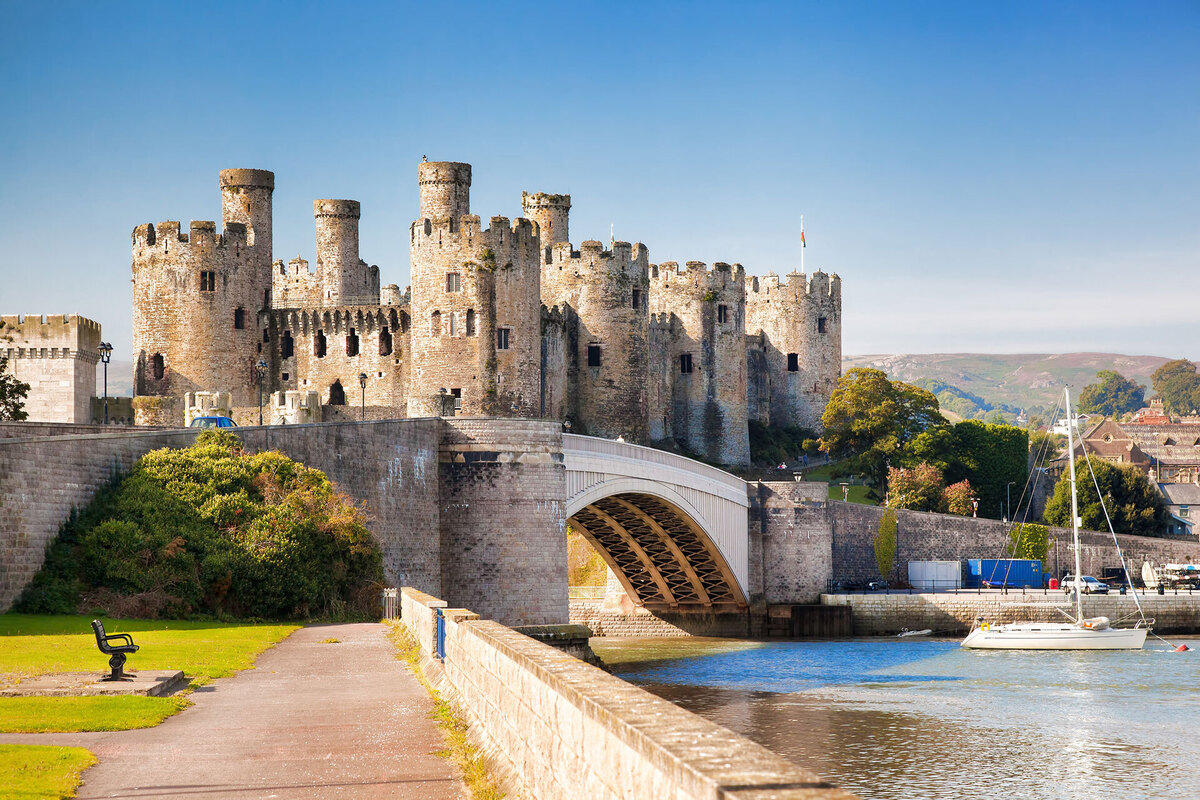
This afternoon, for those who wish to join us, we enjoy a dose of royal culture with a visit to one of the finest preserved castles in Britain. Located a mere 45-minute drive from Holyhead, the medieval fortress of UNESCO World Heritage listed Castell Conwy has dominated the crossing of the River Conwy for over seven centuries. Rich in royal stories, it contains the most complete set of medieval royal apartments in Wales, offering a rare insight into the lives of the English monarchy. While much of the interior now stands as atmospheric stone chambers, the castle’s soaring curtain walls and eight great towers remain as imposing today as when first built, and restored spiral staircases allow visitors to walk a full circuit of the battlements.
Beyond the walls, the rugged peaks of Eryri (Snowdonia) rise in the distance, while below lies the harbour town of Conwy, still encircled by its remarkably intact medieval walls. Designed for Edward I by his master architect James of St George the 13th century castle forms part of a UNESCO World Heritage Site. Grand in scale and rich in history, Castell Conwy stands as a powerful reminder of royal authority in medieval Wales.
In the morning we arrive in Northern Ireland at Rathlin. For those who wish to join us we set out on a 7 km (4.2 mile) walk along quiet lanes towards the Seabird Centre on the island’s rugged west coast, where we meet the islands squawking inhabitants. By late April, the cliffs generally come alive as seabirds return to breed. Puffins start to gather at their burrows, while guillemots and razorbills crowd narrow ledges, and kittiwakes call overhead as they rebuild their nests. Fulmars, closely related to albatrosses, glide effortlessly along the cliff faces on stiff wings, using the Atlantic winds to hover almost motionless in the air. At this early stage of the season, numbers are building and activity is constant as birds establish territories and pairs bond. Though still early in the season, Rathlin is already one of the most important seabird sites in Britain, renowned for its dramatic and densely populated cliffs.
For those who'd prefer to view the islands cliffs, sea caves and marine life from sea-level, we'll search the coastline around, and south of, Church Bay on our Zodiacs. Cruising the shoreline we'll likely find the islands grey seal population and possibly fulmars, kittiwakes, guillemots and razorbills who start to gather here from April.
On the west coast of the Isle of Skye, we zodiac ashore to the private pier of Dunvegan Castle, set on the shores of Loch Dunvegan and the ancestral seat of Clan MacLeod, long‑standing rivals of the MacLean's for over 800 years. At the heart of clan life stood the castle itself, a centre of authority, protection and identity, where chiefs governed their people and defended their lands.
At Dunvegan, we explore richly furnished interiors where portraits, heirlooms and treasured relics tell the story of the MacLeods, whose lineage continues to this day. The clan’s history is not only one of rivalry and survival, but of continuity, with descendants still connected to the estate and its traditions.
There is also time to wander through the surrounding gardens and woodland estate, where paths lead through formal plantings, sheltered glades and down to the loch. Developed from the 18th century and carefully expanded over generations, the gardens reflect both heritage and renewal. In recent years, efforts by the estate have focused on conservation and replanting, restoring woodland and encouraging biodiversity, ensuring that Skye’s landscape, like the clan itself, continues to evolve while remaining deeply rooted in its past.
We zodiac ashore near Duart Castle at Craignure, located along the coast from Tobermory, the charming capital of the Isle of Mull.
Mull itself is a land of dramatic coastlines, heather-clad hills and friendly locals. Throughout history, the sheltered waters of the Sound of Mull have provided a vital refuge for shipping navigating Scotland's rugged west coast, especially during World War II when it played an unexpected but vital role in Britain's war effort. The town became home to HMS Western Isles, the Royal Navy's renowned anti-submarine training school. Escort vessels bound for convoy duty in the Atlantic underwent rigorous training here under the watchful eye of Vice Admiral Sir Gilbert Stephenson, whose demanding methods earned him the nickname "The Terror of Tobermory". The skills learned in these waters helped Allied sailors protect vital supply routes during the Battle of the Atlantic.
On arrival we head to ‘clan country’ with a visit to the seat of Clan MacLean; Duart Castle. Rising above the Sound of Mull, its position reflects the realities of clan life, where command of the sea was as vital as control of the land. More than a family, a clan was a network of kinship, loyalty and territory, bound to a chief whose authority shaped daily life, defence and identity across the Highlands and islands. Duart stood at the heart of this system, both fortress and home, its walls bearing witness to centuries of alliance, rivalry and resilience.
We tour the castle and admire its dramatic setting, exploring its restored interiors while taking in sweeping views across the surrounding waters. Though the traditional clan system was suppressed after the Jacobite uprisings, its legacy endures. Descendants are now spread across the world, yet many still look to Duart, where history, landscape and lineage remain inseparably linked.
Choose to head back to the ship for lunch or join our shuttle to Tobermory. Framed by a crescent of brightly painted waterfront buildings, Tobermory is one of the Hebrides' most picturesque settlements, with a rich maritime heritage and a warm island welcome. Perhaps enjoy a dram at the visitor centre of the historic Tobermory Distillery, sample a traditional lunch in an authentic local pub, or browse the independent galleries, craft shops and boutiques that line the waterfront, before we sail south late-afternoon.
In the heart of the Irish Sea, this tax‑free island is steeped in ancient mythology. Its name, ‘Man’, is thought to derive from Manannán mac Lir, the Celtic Sea god and legendary ruler. Today, the Isle of Man combines rugged coastlines and medieval heritage with modern life as a self‑governing Crown Dependency. Its parliament, Tynwald, is believed to be the world’s oldest continuous legislature, reflecting a history shaped by Celts, Vikings and later the British Lords of Mann.
Early morning we anchor off the 600-acre islet of the Calf of Man. From here, our Zodiacs carry us ashore to explore this wild and windswept outpost, long prized by naturalists and photographers alike.
The island is renowned for its birdlife, with around 30 species of seabirds breeding here, including Manx shearwaters, kittiwakes, razorbills and shags, while birds of prey such as peregrines and hen harriers are often seen overhead. As we walk towards the bird observatory, we may also encounter Manx Loaghtan sheep, their multi‑horned silhouettes adding to the island’s character, while along the shoreline grey seals are often seen resting on the rocks or moving through the surf. Along the cliffs stand the island’s distinctive twin lighthouses, one perched high above the sea and the other dramatically at water’s edge, while offshore, the solitary tower of Chicken Rock Lighthouse rises from the sea. Together, this trio forms a historic navigation system guiding ships through the hazardous waters of the Irish Sea and the Calf Sound.
Over lunch we sail to the Isle of Man itself and the historic fishing port of Peel, which you’ll have time to explore at your leisure. You may wish to stroll along the harbour, relax over a pint at a local pub, or visit Peel Cathedral, modest yet steeped in island tradition. Dominating the headland is Peel Castle, founded by the Vikings in the 11th century and later serving as a royal residence, centre of government and military stronghold. Set within the walls are the ruins of churches and halls, offering a fascinating glimpse into centuries of Manx history.
Sailing for Britains neighbouring island, we bid you farewell with a group departure transfer to Dublin airport.
Meals: Breakfast onboard