

Welcome to Vantage Explorations’ Lisbon to Amsterdam: Coasting the Atlantic
From the sunlit streets of Lisbon to the sultry canals of Amsterdam, this voyage follows a coastline that for centuries has farewelled emigrants, explorers, and pilgrims on journeys of ambition, faith, and exchange. Sailing in their wake, we’ll visit a world that once launched ships from ‘the edge of the known world’ to the ends of the earth, welcomed travellers in search of meaning, and traded everything from spices to silk to secrets. Along the way, you’ll wander medieval lanes, climb the steps of religious icons, hike famed paths, and feel the powerful draw of the sea as you journey Europe’s most storied shoreline when we ‘coast the Atlantic’.
Arrive at Humberto Delgado Airport and transfer to our Embarkation Suite (conditions apply below). Explore Lisbon at your leisure before returning to our Embarkation Suite at the designated times for the group transfer to Douglas Mawson.
Important information:
- Complimentary airport arrival transfers are provided as group transfers for expeditioners arriving at Humberto Delgado Airport prior to 12:00pm on Day 1 only.
- Passengers who arrive after the airport transfer cut-off will need to make their own way to the Embarkation Suite before 2:00 pm to complete mandatory check-in.
- For passengers already in Lisbon, we ask you to visit our centrally located Embarkation Suite with all luggage, which will be open for mandatory check-in between 9:00 am and 2:00 pm.
- Passengers have access to our centrally located Embarkation Suite, including luggage storage, Vantage Explorations staff for voyage and city information and cabin check-in, WIFI, tea, coffee and light refreshments. Embarkation Suite location: to be advised closer to date of departure.
- As your luggage will be transported to the ship at 2.30pm and ahead of you, please ensure you place any items you require during the day in your day bag, including passports, cash/cards and medicines.
In the late afternoon join a mandatory group transfer to board the Douglas Mawson. After boarding, there’s time to settle into your cabin before our important safety briefings before we ‘throw the lines’ to begin our voyage.
This evening, join your fellow travellers for an onboard Welcome Dinner, where your expedition team will introduce you to the expedition ahead and raise a toast to the adventures to come.
Meals: Dinner onboard
Arriving at midday we arrive at Leixões, the port for Portugal’s ‘second city’; Oporto. This eclectic city entices visitors with its storied past, vibrant culture, and architectural splendour for it was in Oporto that the Portuguese ‘Age of Discovery’ began when the indomitable Prince Henry the Navigator set sail to the western coast of Africa in the early 15th century. The city frames the Douro River with its picturesque streets, iconic iron bridges, and renowned wine cellars. In the UNESCO World Heritage ‘old town’ of Ribeira, a colourful blend of Romanesque, Gothic and baroque architecture adds to the lively atmosphere, while Oporto’s historical Rabelo boats, once vital for transporting port wine barrels, grace the riverbanks.
Our locally guided walking tour begins in Ribeira, Porto’s oldest quarter, where the city first took shape along the Douro. Settled since Roman times and flourishing in the Middle Ages, this was once a busy port where merchants, fishermen, and traders crowded the quays, shipping wine and goods across Europe. Today, its colourful houses and narrow lanes still follow that medieval footprint, rising steeply from the river and preserving the feel of a working waterfront that has barely changed in centuries, now part of a UNESCO‑listed historic centre.
From here we cross the Dom Luís I Bridge, the striking two‑level iron span that defines Porto’s skyline. Often mistaken for the work of Gustave Eiffel, it was in fact designed by his former partner Théophile Seyrig, which explains its bold, industrial elegance.
We climb into the Sé district, where narrow streets wind uphill to the Porto Cathedral, one of the city’s oldest monuments. Its fortress‑like appearance reflects its medieval origins, with thick defensive walls and narrow openings built for protection as well as worship. From here, we descend gently into the city to São Bento station, where the atmosphere shifts once again. Inside, it famed vast panels of blue‑and‑white azulejo tiles depict scenes from Portugal’s history, battles, royal events, and rural life, turning a working station into a kind of living gallery. Finally, wander back down toward the river, returning to the bustle of the waterfront where you can easily navigate the city for further exploration.
For those who wish to join us our afternoon includes one of Oporto’s quintessential experiences; a guided tour of a port cellar. Here, the renowned port wine, crafted in the Douro Valley, is aged and stored in traditional caves.
Our guide will introduce you to various types of port wine and offer tastings, allowing you to appreciate the distinct characteristics of each. The cool, dimly lit cellars create an atmospheric setting as you delve into the history and craftsmanship behind this iconic Portuguese wine.
Having sampled some of Portugal’s ‘favourite tipple’, choose to return to the ship or remain in town and join our shuttle to the port of Leixões, with Douglas Mawson sailing late evening.
Spain’s ‘secret garden’ is the verdant region of Galicia. This less-visited section of the country is a true gem, beloved by Spanish travellers. Locals still speak Galician, and the blonde, blue-eyed inhabitants proudly hold on to their Celtic heritage. As one of its nation’s leading fishing ports, Vigo’s bustling harbour is a testament to centuries of seafaring tradition. The city’s history is also intertwined with the Camino de Santiago, with pilgrims traditionally arriving by sea before embarking on their journey to Santiago de Compostela. Visitors can enjoy the scenic waterfront, savouring fresh seafood at local restaurants, or explore the historical shipyards, which echo with tales of old. With its lively festivals, lengthy beaches and welcoming atmosphere, Vigo provides a glimpse into Galicia’s coastal heritage.
Our next two destinations afford us the opportunity to walk a section of the famed Camino de Santiago, with our first commencing a 45-minute drive across the bay from Vigo in the historic town of Baiona. Sheltered beneath the walls of the MonteReal fortress, the Bay of Baiona became the first place in Europe to learn of the discovery of the New World. It was here, in 1493, that La Pinta arrived from across the Atlantic, bringing news of Christopher Columbus’s historic voyage.
From the harbour, we walk into Baiona’s old town, a compact network of narrow streets shaped by centuries of maritime life. Climbing gently, you reach the fortress walls, where views stretch across the bay and out to the Atlantic, once scanned for returning ships carrying trade, travellers, and news from distant shores.
From here we start the first of our camino walks. Beyond the town lies the Camino de Santiago, a route that has drawn pilgrims for more than a thousand years. For centuries, it has offered travellers the chance to undertake a journey both physical and spiritual, whether in fulfilment of a vow, in search of purpose, or simply for the experience of the path itself. Today, pilgrims continue for many reasons: faith, self‑discovery, or the quiet challenge of the road.
Our walk follows a portion of a section of the Camino de Santiago known as the Portuguese Coastal Way, sharing the same path still used by pilgrims today. Covering around 5 kilometres (3 miles), the route unfolds gently along the coast, marked by the familiar shells and arrows that guide the way. Gradually, the path turns inland, leading to the stone bridge at A Ramallosa. This classic structure, medieval in form and likely built upon earlier foundations, has carried travellers across the river for centuries. It marks a quiet but meaningful stage along the journey north.
Having completed todays pilgrimage we return to Vigo for an afternoon of independent exploration, before continuing along the Galician coastline in the late afternoon towards A Coruña.
A Coruña seamlessly blends its rich maritime heritage with its role as a dynamic modern city. The picturesque waterfront beckons both locals and visitors to stroll its streets, savour local wines at welcoming bars, indulge in fresh Atlantic seafood, and immerse themselves in the many cultural festivals on its annual calendar.
Today we walk a further section of the Camino de Santiago, with our destination being Santiago de Compostela, Europe’s most significant pilgrimage city. Once a major site during the Spanish Reconquista, Santiago was heavily damaged in the 10th century by Moorish invaders, igniting Christian Iberia’s passion and spurring a resurgence centred on the city’s fervour for St James. Today, its Old Town, with its blend of Romanesque, Gothic and baroque architecture, is renowned as the endpoint of the 790-kilometre (491-mile) Camino Francés pilgrimage route.
Our one‑hour drive brings us towards La Calzada, where we step onto the Camino and, for a time, become pilgrims ourselves. From here, we follow a 4- 5 km (3 mile) stretch of the historic route toward Santiago. The landscape unfolds gently, shifting from pine groves to open meadows and farmland, with a varied underfoot path of soil, gravel, and worn stone—echoing the footsteps of those who have passed here for centuries.
Having stretched our legs and taken time to reflect along the way, we continue onward to Santiago de Compostela for lunch. Here, you will dine at a traditional pilgrimage-style parador, where hearty Galician cuisine is served. Regional specialties take centre stage, including the ever‑popular octopus (pulpo), alongside other simple yet flavourful dishes rooted in the local landscape and traditions.
Re‑energised, we set out on a guided walking tour through the historic heart of the city. Along the way, you pass landmarks such as the Town Hall, the stately Pazo de Raxoi, and the Palace of San Jerónimo, before arriving at the magnificent Praza do Obradoiro—Santiago’s grand central square.
The highlight of your visit is the Cathedral of Santiago de Compostela, begun in the 12th century. Its impressive façade reflects a blend of architectural styles, the result of centuries of transformation. Inside, the cathedral holds deep spiritual significance: it is believed to house the remains of Saint James the Apostle, making it one of the most important pilgrimage destinations in the Christian world. Passing through its doors, you enter not only a remarkable building, but a space shaped by faith, tradition, and the shared experience of countless pilgrims who have completed their journey here.
Returning to the ship, we sail to France late afternoon.
After two days walking portions of the historic Camino de Santiago, today is an opportunity to relax and recharge. Rest your legs, unwind in the sauna, soak in the Jacuzzi, or simply find a comfortable spot on deck and enjoy the ever-changing views at sea.
As we sail north towards the shores of Brittany and Normandy, join our onboard experts for a series of engaging presentations exploring the regions' distinctive cultures, rich maritime traditions, Celtic roots, historic ports, and pivotal role in shaping the history of France. These insightful talks provide the perfect introduction to the landscapes, people and stories that await us in the days ahead.
Our 45-minute drive brings us to the coast at the small harbour of Le Conquet, once a strategic outpost guarding the western approaches to Brest. From here we set out along the famed GR34 coastal path, following the rugged edge of Brittany’s Atlantic coast, in search of both ancient and more recent historical sights, with time to experience Brittany at its best with a free afternoon to relax in the coastal enclave of Le Conquet.
The coastal walk from Le Conquet to Pointe Saint‑Mathieu covers approximately 6 km (3.5 miles) and centuries of history. Throughout, the everchanging light, expansive views, and powerful sense of place make this one of the most memorable coastal walks in Brittany, a journey where natural beauty and the regions past are inseparably entwined.
Leaving the harbour behind, the path quickly becomes fully coastal, winding across open headlands and along clifftops with uninterrupted views over the Atlantic. Wind and sea define this landscape, and the growing sense of exposure reveals why this coastline has long been of strategic importance.
Here, the remains of the Brittany section of the 2700 km (1,670‑mile) Atlantikwall begin to emerge. Constructed by Nazi Germany along the coasts of seven nations during World War II, this vast defensive system was designed to repel an Allied invasion from the sea. In Brittany, these fortifications were concentrated around the strategically vital naval base at Brest, one of the principal ports used by the German navy and its U‑boat fleet.
As the war turned in 1944, Brest became a key objective for the advancing Allied forces. Fiercely defended by German troops, the city endured a prolonged siege and heavy bombardment. When Brest was liberated in September 1944, much of the city lay in ruins, and the port had been so extensively damaged that it was of little immediate use to the Allies.
Today, scattered bunkers and gun positions still line the cliffs, some reduced to fragments, others standing stark against the elements as reminders of this heavily fortified coastline.
Our walk continues to the dramatic headland of Pointe Saint-Mathieu, where the ruins of a medieval abbey stand beside a working lighthouse. Nearby, former German command posts and artillery positions overlook the sea, while the Musée Mémoires 39-45, housed in a remarkably well-preserved bunker, offers compelling insight into life along the front line of occupied Europe and the Battle for Brest.
On returning to Brest, the city is yours to explore with your afternoon free, prior to our early evening departure.
We sail the most western point of Brittany overnight to reach the coastal town of Roscoff. The city’s old town is deeply connected to its maritime heritage, the all-important French onion trade and the uniquely local business of seaweed collection. The bustling old port is a focal point year-round, accommodating commercial fishing boats, recreational vessels, and traditional ‘goémoniers’.
We head half an hour inland this morning to spend time in one of the region’s historic towns. Nestled in a deep valley where the River Dossen meets the sea, the Breton town of Morlaix is renowned for its striking natural setting. Accompanied by a local guide, we begin our walk beneath its most iconic landmark: the great 19th‑century viaduct, built to carry the railway between Paris and Brest. During the Second World War, this vital link drew the attention of Allied forces, and the town suffered bombing raids aimed at destroying it—yet remarkably, the viaduct survived and continues to dominate the skyline today, affording us the unusual opportunity to walk across its lower level, enjoying sweeping views over the rooftops and river below.
From here, we enter the historic centre, where Morlaix’s medieval prosperity comes vividly to life. In the 15th and 16th centuries, the town flourished as a busy port, and its wealthy merchants left behind a legacy of multi-storied, timber‑framed maisons à pondalez, known as ‘lantern houses.’ We will step inside one of these remarkable homes, with its carved wooden galleries and central open hall, offering a fascinating insight into the craftsmanship and ambition of the period.
Our walk continues through narrow cobbled streets and the hidden alleyways that thread the town, leading us past the Gothic Church of Saint‑Melaine, later closed during the French Revolution and used as a food storage centre before being restored to worship. Along the way, we explore Morlaix’s layered streetscape of courtyards, façades, and quiet corners, revealing a town that remains a living record of Breton history.
At the end of the tour, you may choose to return directly to the ship for lunch, with an afternoon free in Roscoff, or remain in Morlaix to enjoy additional time at leisure, with a later transfer provided back to port.
As we head towards Normandy, our small size allows us to dock at the charming city of Saint-Malo. Though this tidal port can be challenging to access, it’s well worth the effort. Saint-Malo offers a range of captivating experiences for us to enjoy. Perched on the border of the former kingdoms of Normandy and Brittany, the walled city of Saint- Malo with its medieval architecture, cobblestoned streets, and shops stacked with delicious Breton treats, is a true ‘pirate town’. This era of ‘privateering’ as it was known earned Saint- Malo the nickname ‘City of Corsairs’ and contributed significantly to the prosperity of the Sun King Louis XIV who legalised local sailors to attack foreign ships in return for a portion of their ‘booty’. As the final coastal stronghold of the Nazi’s in World War II much of Saint- Malo was destroyed by Allied bombing but in the true Breton spirit the town was painstakingly rebuilt to its reflect its former self. Today, Saint- Malo celebrates this heritage through its museums, festivals, and preserved historic sites, offering visitors a glimpse into its adventurous past.
Personalise your exploration with our included ‘Your Choice’ experiences.
Option 1 – Morning experience: The Privateer Town of Saint-Malo
Join our local guide this morning for a walking tour of Saint-Malo’s historic walled town. Encircling the old town in a continuous loop of approximately 2 kilometres (1.2 miles), these walls form both a defensive boundary and a spectacular walkway, offering sweeping views across the Channel, beaches, and harbour.
Standing proudly behind its stone ramparts, Saint-Malo boasts a captivating history more closely tied to privateering than outright piracy. From the 16th to the 19th centuries, Saint-Malo was renowned as a bastion for the wealthy privateers known as corsairs. These state-sanctioned sailors, authorised by the French crown, were tasked with attacking and capturing enemy ships during times of war. Unlike pirates, who operated independently and unlawfully, privateers acted under official letters of marque and reprisal, sharing their spoils with the French kings. The corsairs of Saint- Malo were highly skilled and daring seafarers who played a crucial role in French naval warfare and overseas trade. They conducted raids on English and other enemy ships, bringing back wealth and prestige to Saint-Malo. This era of privateering earned Saint-Malo a notorious reputation, brought to life through captivating tales of its most famous, or infamous, privateers and their treacherous lifestyles.
Option 2 – Morning Experience: Saint-Malo Under Siege
Join a locally guided walking tour exploring Saint-Malo’s dramatic role in World War II. Declared a "fortress" by Hitler, Saint-Malo became one of the most fiercely contested Nazi strongholds in France, enduring a devastating Allied siege that left nearly 80 per cent of the historic city in ruins before its liberation in August 1944.
As you walk the rebuilt streets and ramparts, you'll hear stories of occupation, resistance, and survival, inspired by Anthony Doerr’s All the Light We Cannot See. This unique tour blends the novel’s setting with the real events that unfolded here as you follow in the footsteps of the fictional heroine Marie-Laure through the narrow lanes of the old town, learning about the courage of the French Resistance, and discovering how ordinary residents endured bombardment, uncertainty, and loss.
This poignant tour offers a powerful insight into the resilience of Saint-Malo and the determination of its people in the face of overwhelming adversity.
Option 3 – Half-Day experience: Mont Saint-Michel
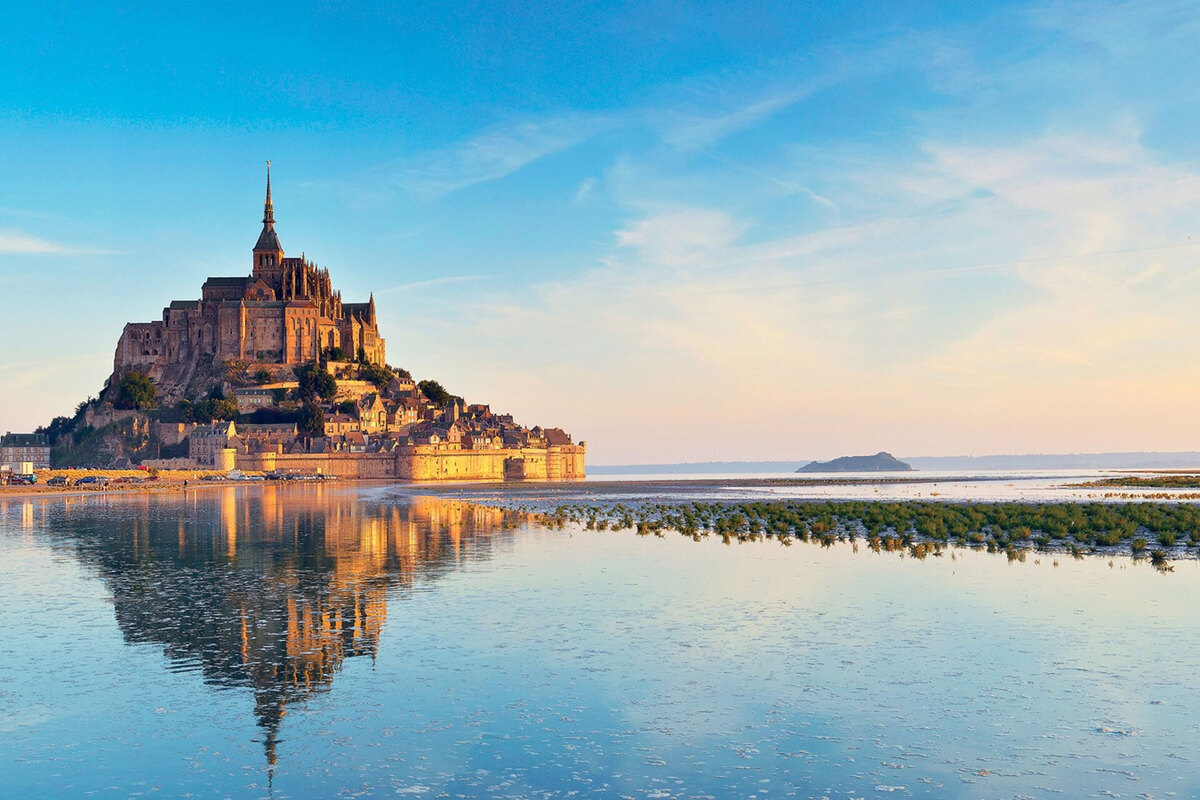
Normandy’s most recognisable silhouette, UNESCO World Heritage-listed Le Mont Saint-Michel has captured the imaginations of pilgrims, artists and travellers for centuries. Founded as a monastery in the 8th century, Le Mont-Saint-Michel became a significant pilgrimage destination during the Middle Ages. Visitors can explore the abbey’s intricate chapels, cloisters and panoramic viewpoints, which offer sweeping vistas of the bay. Reaching the abbey involves a climb of around 350 steps, winding through the narrow streets of the village below, lined with centuries old houses, shops, and small inns. At the summit, visitors can explore the abbey’s chapels and cloisters, while panoramic viewpoints reveal sweeping vistas across the tidal bay.
According to Christian tradition, Saint Michael is the archangel of judgment, weighing souls and casting out evil. Often depicted in elevated positions, he symbolises a heavenly guardian overlooking the faithful below. Mont-Saint-Michel itself reflects this powerful imagery, rising dramatically from the surrounding flats, a singular landmark where spirituality, architecture, and landscape come together. Note: Guided visits to the abbey are regulated by time slots. The duration of this experience will not be known until weeks prior to the date.
Our excursion today follows the western landings of Operations Overlord. We arrive at the port of Cherbourg which occupied a position of immense strategic importance. Located at the tip of the Cotentin Peninsula, its deep-water harbour was one of the finest in Europe and a vital objective for the Allied forces following the D-Day landings in Normandy.
On 06 June 1944, Allied forces launched a campaign to liberate Europe named Operation Overlord that would alter the course of World War II forever. Following the footsteps of those who fought and fell, we gain a profound understanding of the immense courage exhibited by the participating forces and their enduring legacy. Many came ashore at a seven-kilometre stretch nestled between Vierville-sur-Mer and Colleville-sur-Mer, now known as Omaha Beach. Flanked by steep cliffs, this strategic location was heavily fortified with field guns, mortars and machine guns, creating a formidable defence. Despite knowing the risks, the Allies had no alternative but to proceed with the assault. Trapped on the beach amid a scene of chaos it took them nearly six hours to overcome the obstacles, scale the embankment and reach the plateau. By evening, their advance had barely extended one mile inland.
Visiting the Normandy American Cemetery and Memorial is a deeply moving experience. Established on 8 June 1944, it became the first American cemetery on European soil during World War II. Spanning 172 acres, the cemetery is the final resting place for 9,389 military personnel, many of whom lost their lives during the D-Day landings and subsequent operations. The site includes the Walls of the Missing, where 1,557 names are inscribed, with rosettes marking those who have been identified since.
Our day includes time spent at the Omaha memorial and the visitor centre. One-third of the 30,000-square-foot building is dedicated to exhibits featuring personal stories, narrative text, photos, films, interactive displays and artefacts that highlight the courage and sacrifice of the US forces in the Battle of Normandy. The visitor centre pays tribute to the values and sacrifices of the World War II generation, making a visit to this museum a profoundly moving experience. Note: Omaha beach is subject to tides which may limit our visit to the beach and the Les Braves memorial.
On our return to Cherbourg, there may be time to visit La Cité de la Mer independently before we sail in the early evening towards Caen. Located within Cherbourg's historic transatlantic terminal and just a short walk from the ship, this acclaimed maritime museum is home to the nuclear submarine Le Redoutable, exhibitions on ocean exploration, and displays celebrating the city's rich seafaring heritage.
The museum also explores Cherbourg's connection to the great age of transatlantic travel, including the story of the Titanic, which called at Cherbourg on her maiden voyage in 1912 to embark passengers before continuing westward across the Atlantic. Whether you choose to explore the museum's fascinating exhibits or simply admire the impressive Art Deco terminal building, it offers an engaging insight into one of France's most important maritime gateways before we continue our voyage.
We navigate the River Orne in the early hours of the morning, arriving in the historic city of Caen. Guests wishing to continue our exploration of D-Day and the Battle of Normandy may wish to visit the renowned Caen Memorial Museum, widely regarded as one of France's most comprehensive museums dedicated to the Second World War and Operation Overlord. Alternatively, step back nearly a thousand years and uncover Caen's great medieval love story. Follow in the footsteps of William the Conqueror and Matilda of Flanders as we visit the two abbeys they founded to secure papal approval for their controversial marriage.
Personalise your exploration with our included ‘Your Choice’ experiences.
Option 1 – Morning experience: William the Conqueror and his wife, Matilda
Discover the story of William the Conqueror and Matilda of Flanders through a visit to Caen’s two magnificent abbeys. Married in the 11th century, William and Matilda formed one of medieval Europe’s most influential partnerships, helping shape the future of both Normandy and England. Their marriage was initially opposed by the Church because of their close family ties. In response, the couple founded two great Benedictine abbeys in Caen, working religious communities that became important centres of worship, learning and daily life in medieval Normandy.
We begin at the Abbaye aux Hommes, founded by William and home to his tomb, before crossing the historic city centre to the Abbaye aux Dames, established by Matilda and the site of her final resting place. For centuries, monks and nuns lived, worked and prayed within these thriving communities, which played a significant role in the spiritual and cultural life of the region.
Together, these extensive monuments tell a story of love, ambition and legacy. More than architectural masterpieces, they stand as enduring symbols of a partnership that changed the course of European history. Exploring both abbeys offers a fascinating insight into the lives of the man who conquered England and the remarkable woman who helped him build a dynasty.
Option 2 – Morning experience: The Battle of Caen
The Battle of Caen, which unfolded between June and August 1944, was one of the longest and most intense battles of the Normandy campaign. The city was a primary target for the British and Canadian forces, who aimed to capture it quickly. However, German forces, well-entrenched and heavily fortified, put-up fierce resistance, resulting in prolonged and brutal fighting. Caen endured extensive bombing and artillery shelling, leading to significant destruction and civilian casualties, with the city almost entirely reduced to rubble by the battle’s end with the eventual liberation of Caen on 20 July 1944.
Built above the former command post of German General Wilhelm Richter, a critical site during the early weeks of the battle, the Caen Memorial Museum is considered one of the best D-Day museums in France. Offering an immersive exploration of the 6 June landings and their broader impact on the Battle of Normandy, the D-Day exhibit places this pivotal event within the context of the wider campaign, essential to the liberation of France and Europe. Through documents, artefacts, and personal accounts, visitors gain a comprehensive understanding of the invasion’s significance.
We return to the mouth of the River Seine and the last town liberated during the Normandy Campaign: Honfleur. Originally a thriving trading port, Honfleur's strategic position made it one of the gateways between France and the wider world. During the Hundred Years' War it briefly fell under English occupation, while in later centuries its fortunes grew through maritime trade and exploration. Most famously, local navigator Samuel de Champlain departed from here before founding Quebec, helping forge lasting ties between Normandy and New France. The wealth generated by seaborne commerce is still visible today in the tall, narrow merchants' houses that crowd around the harbour, their elegant facades a testament to centuries of prosperity.
A harbour town like no other in Normandy, Honfleur is a picture-perfect corner of France. In the nineteenth century, its appeal extended beyond commerce when Claude Monet followed his mentor, Eugène Boudin, to his hometown. Captivated by the town's extraordinary light, Monet and his fellow Impressionists found inspiration in its harbour, estuary, and ever-changing skies, immortalising them on canvas. Today, the Vieux Bassin remains the heart of the town, where yachts bob beneath centuries-old buildings and a maze of galleries, boutiques, cafés, and seafood restaurants invite visitors to linger.
As fortune would have it, our visit falls on a Saturday, market day, and perhaps the best time to experience the true spirit of Normandy. Here, you'll discover that food is far more than sustenance; it is at the heart of local identity. From celebrated cheeses and buttery pastries to orchard-fresh cider and Calvados, the apple brandy many Normans regard as the very essence of their region, every stall reflects a deep pride in the land, its traditions, and its bounty. There is no better place to experience the rhythms of Norman life, where conversations, celebrations, and daily routines have long revolved around the table.
We'll enjoy an introductory walk with a local guide, with the morning in Honfleur before departing mid-afternoon, our schedule dictated, as it has been for centuries, by the tides of the Seine estuary.
Around midday, we arrive in Ostende, a well‑established Belgian port city that was extensively rebuilt following the destruction of the Second World War.
Belgium itself, renowned for its fine chocolates, world‑class beers, and traditional sport of pigeon racing, sits at the crossroads of Europe. During the height of its merchant and trading power, cities such as Antwerp, Bruges, and Ghent flourished, their wealth built on commerce, textiles, and international exchange. This legacy of trade and prosperity continues to shape Belgium’s identity today, blending historic enterprise with modern creativity.
A 30-minute drive from Ostende, we find the best preserved of these cities; Brugge. Since their creation, Bruges’ purpose‑built canals have connected the city to the sea, forming the lifeblood of its prosperity. These waterways enabled international merchants to trade, transforming Bruges into one of the leading commercial hubs of medieval Europe and a prominent Hanseatic city. By the 15th century, it was equal to 5th Avenue and Harrods combined, with buyers travelling from throughout Europe to buy its high-quality wares. It entered a golden age of wealth and influence, a legacy still visible today in its remarkably well‑preserved opulent architecture.
Walking through its streets, it is easy to see why the entire historic centre has been designated a UNESCO World Heritage Site. Our locally guided walking tour brings this “Golden Age” to life, as we explore Bruges’ medieval buildings, cobbled lanes, and picturesque squares.
With time at leisure, you may choose to indulge in some of Bruges’ renowned Belgian handcrafted chocolates, enjoy a cone of freshly fried fries with mayonnaise, or savour a handcrafted beer in one of the city’s traditional bierkellers. In every corner of Bruges, you encounter a city shaped not by entitlement, but by centuries of enterprise, trade, and the enduring craftsmanship of its people.
After breakfast, you will be transferred to the airport on our group transfer to join your onward flight.
We recommend that you do not schedule your departing flight before 1:00 pm, allowing ample time for a comfortable transfer and check‑in.
Meals: Breakfast onboard